Affichage des articles dont le libellé est capitalisation ; capitalisation ; atelier. Afficher tous les articles

mars 07, 2012

Programme de Facilité Alimentaire de l'UE - Deuxième Atelier de Capitalisation et Clôture des composantes production

Après des longs mois de travail intense, j'ai le plaisir de vous annoncer que le deuxième atelier de capitalisation sur les acquis de la Facilité Alimentaire de l'UE en Afrique de l'Ouest aura lieu à Abidjan du 21 au 23 mars 2012.

L'objectif de cet atelier est de faire une revue par les pairs des produits de capitalisation réalisés par les composantes production dans le cadre du PFA. Ainsi, nous réunirons pour la seconde fois les équipes du Bénin, du Mali, du Sénégal, du Ghana, de la Côte d'Ivoire et de l'ICRISAT pour discuter leur travail. Les travaux seront facilités par la FRAO et le FIDA.

Suite à cet atelier, nous tiendrons également un atelier pour valider le rapport final à soumettre à l'UE sur l'ensemble des activités réalisées lors du PFA.

Les deux ateliers organisés par la division Afrique de l'Ouest et du Centre en collaboration avec le Gouvernement de la République de Côte d'Ivoire, les équipes FIDA en Côte d'Ivoire et avec l'appui de la FRAO et de FIDAfrique se tiendront à l'hotel Ivotel d'Abidjan.

Pour de plus amples informations, n'hésitez pas à me contacter directement:  a.deltorto@ifad.org


décembre 14, 2011

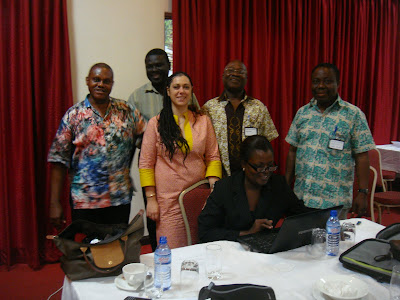
Monitoring and Evaluating the IFAD Country Programme in Ghana - Interactive Workshop on M&E, Accra 12-14 December 2011

by Adriane Del Torto


Monitorting and Evaluation (M&E) is often considered one of the weakest links in development programmes. This is also true for IFAD. The IFAD Country Programme in Ghana took this as a challenge to overcome and started to invest in M&E about two years ago. After putting an emphasis on this theme for some time now, it was finally decided that the stakeholders involved in M&E should get together to share successes and address the gaps that still exist in M&E. From 12 to 14 December, a Ghana Country Programme Learning and Exchange Workshop on M&E took place at the Alisa Hotel in Accra

The workshop , organised by the IFAD Country Office in close collaboration with the West Africa Rural Foundation (WARF) brought together representatives from all IFAD projects, the Roots and Tuber Improvement and Marketing Project (RTIMP), Northern Rural Growth Programme (NRGP), Rural Enterprises Programme( REP II), Rural Agriculture Finance Programme( RAFIP), Northern Region Poverty Reduction Project (NORPREP), WARF, the Government of Ghana - the Ministry of Food and Agriculture (MOFA), Ministry of Finance and Economic Planning (MOFIP) and the National Development and Planning Commission (NDPC) and partners IFPRI/SAKKSS, IPA, University of Ghana, Busylab , Esoko Mobile Technology, in an innovative and interactive workshop.

The overall objective of this workshop is to identify how to use M&E to its fullest capacities. This means using the information generated by M&E on implementation progress as a management tool rather than an institutional requirement. The workshop helped identify outcomes, output and impact of projects while emphasising on the qualitative side of M&E which is often excluded.
The basis of the discussion were the newfound focus on M&E for the Ghana Country Programme, the recommendations from the last country programme supervision mission (which took place mid November to mid December 2011) , the current national and project M&E structures, capitalisation efforts and finally research in M&E undertaken by our implementation partners.

After each project identified the key issues raised by the supervision mission, the partners making their presentations, the workshop allowed each project to review the M&E indicators making sure they are SMART (Specific, Measurable, Achievable, Relevant, Time bound) and ensure that these indicators are the right one to measure the outcomes and impacts desired by the project. It also allowed for the identification of research needs that will improve the M&E and impact reporting


The workshop highlighted the good results in M&E in the Ghana portfolio until now, and also how much these efforts contribute daily to the improvement of the systems and the improvements still needed. Most importantly, projects have shared and exchanged on how to improve their indicators and how to address the difficulties they are facing. Some recurrent themes are the following:


- need to improve data collection at the field level by involving beneficiaries and possibly digitalising
- need to strengthen grassroots institutions
- need for data control at all levels
- need for better data management and analysis
- need for commitment of all actors
- need to fill information gaps through studies
- need to identify, undersand and maintain linkages
- need for better gender mainstreaming
- need to identify further partnerships through good planning


Each project came up with an action plan during the workshop that will be mainstreamed into the AWPB to ensure its implementation.


Most importantly, a topic that came up on many occasions is the importance of good communication and the importance of making the time to exchange on the positive outcomes achieved. In order to ensure good communication there are several Fora in Ghana to ensure exchanges between stakeholders on themes of on microfinance, rural finance and value chains. Furthermore, WARF and FIDAFRIQUE are imporant partners in Ghana but also for IFAD projects in West and Central Africa: they help will ensure that the information to be shared is well articulated and diffused on the regional platform.

Outstanding challenges and considerations for the future are how to make adequate time to engage in proper M&E activities and to ensure that the lessons learned from good M&E fit into policy dialogue.

All workshop docs are available for download (see top right frame)


juillet 11, 2011

Atelier de formation sur la gestion des savoirs

Sur demande du PRODER 3, FIDAfrique va faciliter du 18 au 22 juillet 2011 à Brazzaville un atelier de formation sur la gestion des savoirs destiné aux staffs des projets de deux Congo.

L’objectif de l’activité de former les personnels des projets de la RDC et de la République du Congo en Méthodes et Techniques de Capitalisation des Expériences et des Innovations. La formation va permettre aux participants de :
  • Acquérir des connaissances et des capacités requises en matière de capitalisation des expériences et des innovations.
  • Elaborer des plans de capitalisation et de promotion des innovations au sein de leurs projets respectifs, pour une plus grande efficacité et efficience de leurs projets.
  • Créer une plateforme nationale de partage
  • S’initier aux outils de partage (web notamment)
 Résultats attendus
  • Les participants ont acquis des connaissances et des capacités requises en matière de capitalisation des expériences et des innovations. 
  • Les participants ont élaboré des plans de capitalisation et de promotion des innovations au sein de leurs projets respectifs, pour une plus grande efficacité et efficience de leurs projets. 
  • Une plateforme nationale de partage est crée.
  • Les participants sont initiés aux outils de partage (Web)
Le nombre de participants est limité à 30.

Télécharger
Grille d'évaluation
Note conceptuelle de Capitalisation